
Watch: What is uveitis, and how is it different from pink eye? (about 5 minutes)
The short answer
Uveitis (you-vee-EYE-tis) is inflammation, meaning redness and swelling, inside the eye. It affects the uvea, the middle layer of the eye that’s full of blood vessels. Signs can include a red eye, eye pain, sensitivity to light, blurry vision and new floaters. Unlike pink eye, it happens inside the eye, and without treatment it can cause lasting vision loss. If you have a red, painful eye and light hurts, see an eye doctor right away.
A red, achy eye is easy to blame on pink eye or allergies. Most of the time, that’s all it is. But when the eye also hurts deep inside, bright light is hard to take, and your vision is blurry, the problem may be inside the eye, not on the surface. One cause is uveitis.
This guide explains what uveitis is, how to tell it apart from pink eye, what causes it, and how it’s treated.
Key Takeaways
- Uveitis is inflammation inside the eye, in the middle layer called the uvea.
- Common signs: a red eye, eye pain, sensitivity to light, blurry vision and floaters.
- It often starts suddenly.
- It can be linked to autoimmune diseases, infections or an eye injury, but often no cause is found.
- Without treatment, it can lead to lasting vision loss.
- Treatment usually starts with prescription eye drops that calm the inflammation.
- A red, painful eye with light sensitivity needs an eye exam right away.
See an eye doctor right away if…
Your eye is red and painful, bright light hurts, and your vision is blurry. Call Healthy Vision Institute at 727-738-5900. After hours, or if you can’t reach us, go to the emergency room.
What Is Uveitis?
Think of your eye like a tennis ball with three layers: a tough outer shell, a soft middle layer, and an inner lining. The middle layer is the uvea. It’s full of blood vessels that feed the eye, and it includes the iris, the colored part of your eye.
Uveitis means that middle layer is inflamed. Because it’s inside the eye, it can harm nearby parts you need to see, like the lens and the retina.
Types of Uveitis (Including Iritis)
Doctors name uveitis by where the inflammation is:
| Type | Where it is | What to know |
|---|---|---|
| Anterior uveitis (iritis) | The front of the eye, including the iris | The most common type. It often starts suddenly with a red, painful, light-sensitive eye |
| Intermediate uveitis | The middle of the eye | Often shows up as floaters and blurry vision |
| Posterior uveitis | The back of the eye, near the retina | Can come on slowly and last a long time |
| Panuveitis | All layers at once | The most widespread type |
Uveitis can be a one-time problem, or it can come back.
Uveitis vs. Pink Eye: How to Tell the Difference
| Pink eye | Uveitis | |
|---|---|---|
| Where it is | The surface of the eye | Inside the eye |
| How it feels | Itchy or gritty | A deep ache or pain |
| Light | Usually OK | Bright light hurts |
| Vision | Usually clear | Often blurry |
| Discharge | Often crusty or sticky | Little or none |
| What to do | Call your doctor if it doesn’t improve | See an eye doctor right away |
You can’t always tell on your own. If a red eye comes with pain and light sensitivity, get it checked.
Uveitis Symptoms
- A red eye
- Eye pain or a deep ache
- Sensitivity to light
- Blurry vision
- New floaters, the small dark spots or squiggly lines that drift across your vision
Symptoms often start suddenly, and they can happen in one eye or both. Floaters are common and usually harmless, but new floaters with pain and redness are a reason to call. Our guide to eye floaters explains when to worry.
What Causes Uveitis?
Doctors don’t always know. When a cause is found, it’s often one of these:
- An autoimmune disease, when the body’s defenses attack its own tissue. Examples include rheumatoid arthritis, lupus, psoriasis and multiple sclerosis.
- An infection, such as shingles.
- An eye injury.
Because uveitis can be linked to a condition elsewhere in the body, your eye doctor may order blood tests or other tests, or work with your other doctors.
Who Is More Likely to Get Uveitis?
Anyone can get it. The National Eye Institute says it’s most common in people ages 20 to 60, and smoking cigarettes raises your risk. Having an autoimmune disease, or having had uveitis before, also matters. If you have an autoimmune condition, tell your eye doctor about it.
How Is Uveitis Diagnosed?
The signs of uveitis are inside the eye, so you need an eye exam:
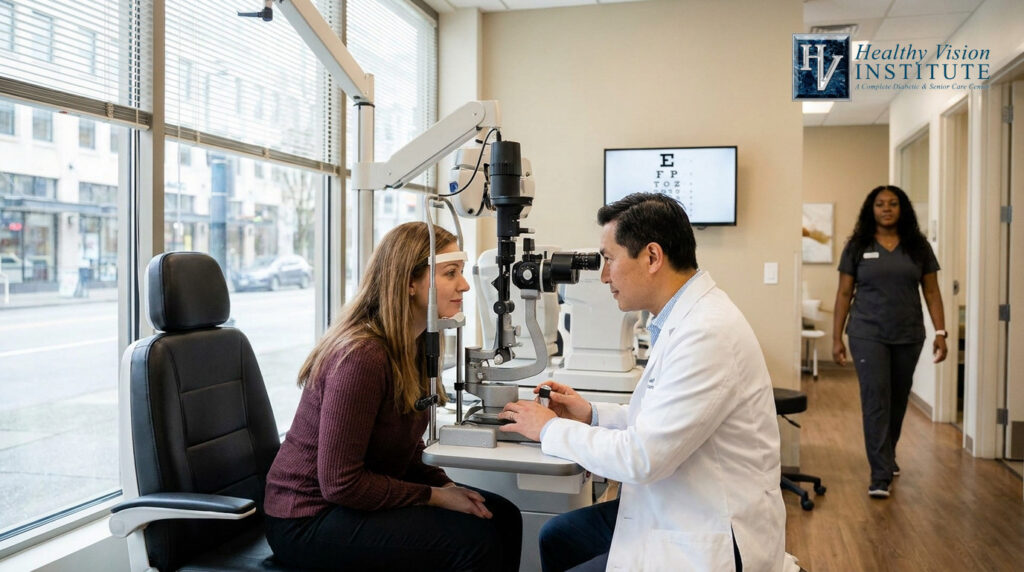
- A close look with a special microscope and a bright light to check for inflammation inside the front of the eye.
- An eye pressure check, because uveitis can affect eye pressure.
- Dilating drops to see the back of the eye.
- Other tests, like blood tests or scans, if your doctor looks for a cause elsewhere in the body.
Uveitis Treatment
The goal is to calm the inflammation fast, ease the pain and protect your vision.
Steroid eye drops
Prescription steroid eye drops are the most common treatment. They reduce inflammation, ease symptoms and help prevent vision loss.
Dilating drops
Drops that widen the pupil can ease the pain and swelling.
Other steroid forms
For deeper or stubborn uveitis, steroids may be given as pills, as a shot in or around the eye, or through a tiny implant placed in the eye that slowly releases medicine.
Treating the cause
If an infection or autoimmune disease is behind it, that gets treated too. Sometimes your doctor prescribes medicine that calms the immune system, and may work with a rheumatologist, a doctor who treats autoimmune diseases.
Don’t stop your drops early
Stopping steroid drops too soon can let the inflammation come back. Follow your doctor’s plan, including slowly lowering the dose, even after your eye feels better.
Possible Complications
Uveitis can damage important parts of the eye and cause permanent vision loss if it isn’t treated. Steroid treatment is very helpful, but it can raise the risk of cataracts, a clouding of the eye’s lens, and glaucoma, which damages the optic nerve. That’s why follow-up visits, including eye pressure checks, matter. Our glaucoma guide explains more.
Why See Dr. Powers
Dr. James Powers, D.O., is a comprehensive ophthalmologist with fellowship training in vitreoretinal surgery. He can check the whole eye, front to back, including the retina, and he watches eye pressure closely during treatment. We see patients in St. Petersburg, Clearwater and New Port Richey.
Frequently Asked Questions
Is uveitis the same as pink eye?
No. Pink eye affects the surface of the eye and usually itches, with discharge. Uveitis is inside the eye and usually causes pain, light sensitivity and blurry vision. Uveitis needs to be seen by an eye doctor right away.
What is iritis?
Iritis is another name for anterior uveitis, inflammation in the front of the eye that includes the iris. It’s the most common type of uveitis.
Is uveitis contagious?
Uveitis itself doesn’t spread from person to person the way pink eye can. If an infection is causing it, your doctor will treat that infection.
Can uveitis cause blindness?
Without treatment, it can cause permanent vision loss. That’s why it’s important to get care right away when symptoms start.
How long does uveitis last?
It depends on the type. Front-of-the-eye uveitis often starts suddenly and can last several weeks. Other types can last much longer or come back.
Can uveitis come back?
Yes, especially if it’s linked to an autoimmune disease. Know your early warning signs, like returning redness, ache or light sensitivity, and call right away if they come back.
Don’t Wait Out a Painful Red Eye
A red eye with pain and light sensitivity is your eye asking for a closer look. Book with Healthy Vision today. We see patients at our New Port Richey, Clearwater and St. Petersburg offices.
Ready to book your appointment?
- New Port Richey: 5413 US Highway 19, New Port Richey, FL 34652
- Clearwater: 2565 Enterprise Rd, Clearwater, FL 33763
- St. Petersburg: 603 7th St S, St. Petersburg, FL 33701
More guides: Glaucoma · Eye floaters · Macular degeneration
Healthy Vision. Healthy Life.
Sources: National Eye Institute, “Uveitis” (nei.nih.gov); American Academy of Ophthalmology, “What Is Uveitis?” (aao.org).
This article is general information, not medical advice for your eyes. For advice about your own eyes, call us or see your eye doctor.